


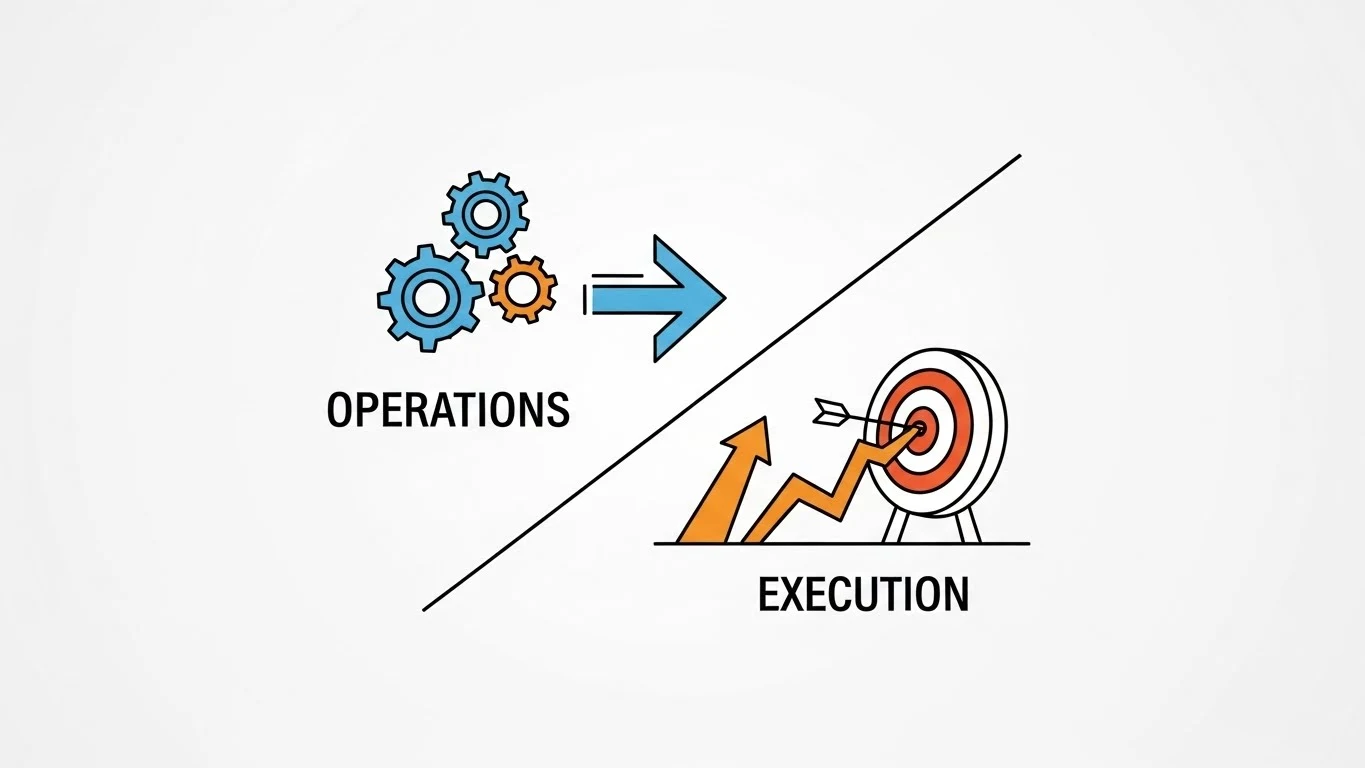
Businesses often struggle not because of a lack of strategy, but because too much attention is spent on execution. When planning and doing are tightly bound together, leaders and teams become absorbed in tasks that limit focus on higher-value decisions. Separating operations from execution creates a strategic advantage by allowing each area to function more effectively.
This separation does not remove responsibility. It redistributes it. Operations define what needs to happen and why. Execution focuses on how and when it happens. When these roles are clearly divided, efficiency improves, and decision making becomes more intentional.
Why Blended Roles Reduce Effectiveness
When operational planning and execution overlap, priorities can blur. Teams spend time solving immediate problems instead of evaluating long-term impact. Strategic thinking gets interrupted by task management, and execution suffers from unclear direction.
Blended roles also increase cognitive load. Switching constantly between planning and doing fragments attention. This makes it harder to assess performance objectively and adjust course when needed. Over time, this fragmentation slows growth and reduces adaptability.
Strategic Focus Thrives with Clear Boundaries
Separating operations from execution allows strategy to breathe. Operations teams can focus on setting goals, defining standards, and identifying risks. Execution teams can concentrate on delivering outcomes without second-guessing intent.
Clear boundaries support accountability. When roles are defined, performance becomes easier to measure. Feedback is more precise, and improvements can be made systematically rather than reactively.
This structure also supports scalability. As complexity grows, separation prevents bottlenecks that occur when the same people are responsible for both direction and delivery.
Execution Improves When It Is Allowed to Specialize
Execution benefits from focus and repetition. When execution teams are not burdened with strategic recalibration, processes become smoother and more reliable. Specialization allows skills to deepen and consistency to increase.
In areas involving logistics and asset movement, this distinction is especially valuable. Coordinating timing, handling, and delivery requires attention to detail that can distract from broader operational priorities.
Arranging services such as Montana vehicle transportation illustrates how separating execution from operations creates clarity. With transport execution handled independently, operational planning can remain focused on outcomes, timelines, and resource allocation rather than daily coordination.
Reduced Risk Through Structural Clarity
Risk often increases when roles overlap. Decisions are made under pressure, and accountability becomes unclear. Separating operations from execution reduces this risk by creating defined ownership at each stage.
Operational teams identify constraints and plan around them. Execution teams manage delivery within those parameters. This structure allows issues to surface earlier and be addressed with less disruption.
Clear separation also improves resilience. When unexpected changes occur, each function responds within its scope, preventing confusion and duplicated effort.
Better Use of Time and Talent
Time and talent are finite resources. Using them strategically requires placing focus where it delivers the most value. Separating operations from execution ensures that planning energy is not consumed by routine tasks and that execution is not slowed by constant strategic reconsideration.
This alignment improves morale as well. Teams gain confidence when expectations are clear and success is measurable. Work feels purposeful rather than reactive.
A Competitive Advantage Built on Clarity
The strategic advantage of separating operations from execution lies in clarity. Clear roles create stronger systems. Stronger systems support faster decisions, better execution, and sustainable growth.
In competitive environments, the ability to focus matters. By allowing operations and execution to do what each does best businesses create space for strategy to lead and performance to follow.